
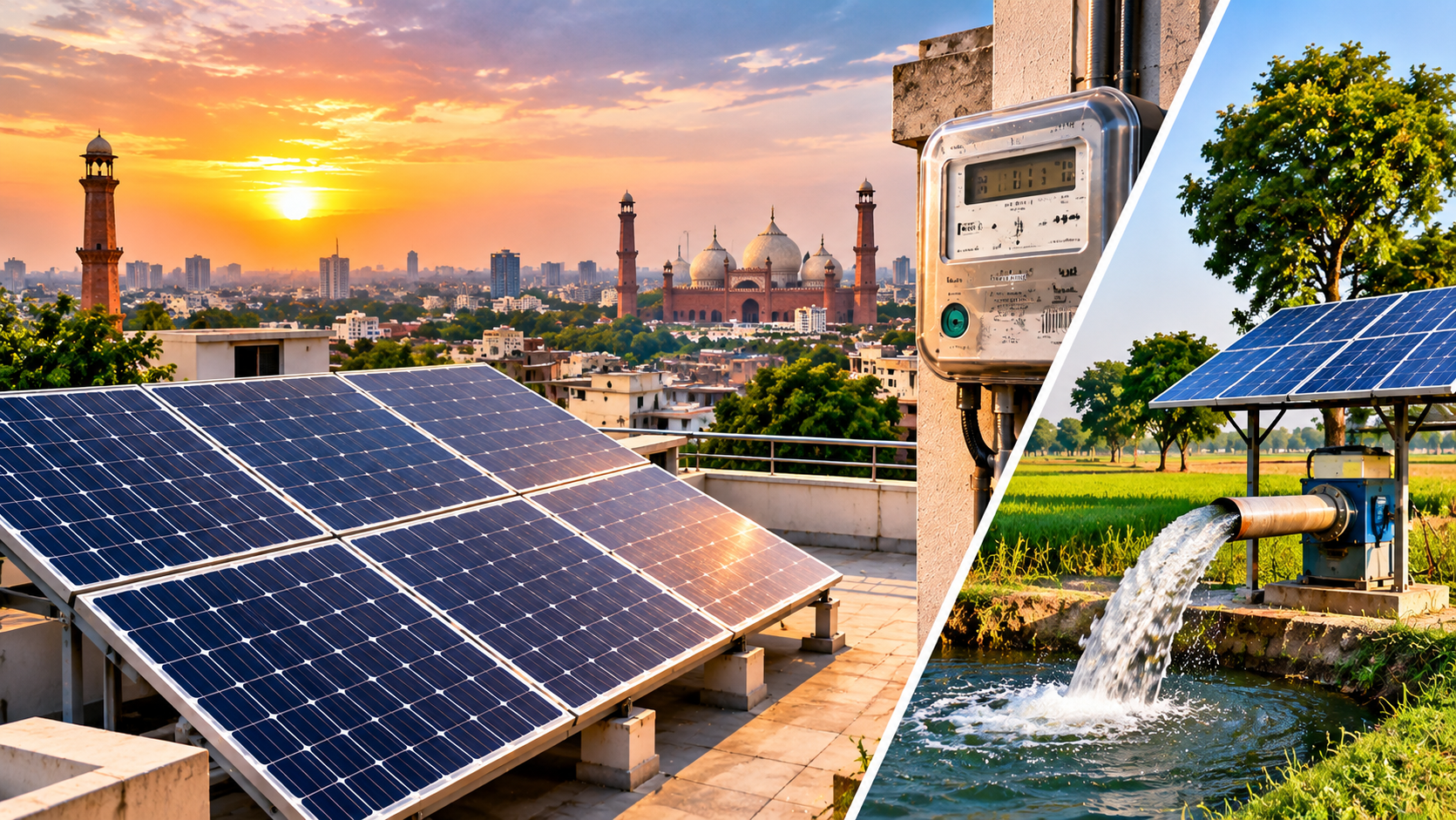
Pakistan is experiencing a major transformation in its energy sector as households, businesses, and agricultural consumers increasingly turn to solar power. However, not all of this growth is visible in official net-metering statistics.
A new research study suggests that Pakistan’s solar expansion is happening through two distinct channels. While registered rooftop solar installations are concentrated in areas with relatively reliable electricity supplies and higher-income consumers, a significant amount of solar adoption is taking place outside the formal net-metering system.
In regions experiencing prolonged power outages and unreliable electricity distribution, consumers are increasingly installing independent solar systems to meet their electricity needs.
The findings highlight how rising electricity prices and frequent power interruptions are accelerating Pakistan’s transition toward distributed solar energy.
Pakistan’s Solar Market Is Growing Through Two Different Channels
Researchers from Pakistan and the United Kingdom have identified two distinct patterns in the country’s solar adoption.
The first is the registered net-metering market, where consumers install rooftop solar systems and export surplus electricity to the national grid under an approved arrangement.
The second is the less-visible solar market, which includes unregistered installations, off-grid systems, and behind-the-meter solar setups that primarily supply electricity directly to consumers.
According to the study, these two markets are driven by different economic conditions.
In areas with relatively reliable electricity supplies, consumers are primarily motivated by rising electricity prices and the opportunity to reduce their monthly bills.
In areas with unreliable electricity distribution, solar adoption is more closely associated with the need for a dependable electricity supply.
This distinction suggests that official net-metering figures do not capture the full scale of Pakistan’s solar energy transition.
Registered Solar Installations Are Concentrated in Major Utility Areas
Pakistan had approximately 6.1 GW of registered net-metering capacity across 378,339 consumers as of June 30, 2025.
The research found that around 85% of this registered capacity was concentrated among six electricity distribution companies:
- Lahore Electric Supply Company (LESCO): 1.3 GW
- Islamabad Electric Supply Company (IESCO): 0.9 GW
- K-Electric: 0.9 GW
- Multan Electric Power Company (MEPCO): 0.8 GW
- Faisalabad Electric Supply Company (FESCO): 0.7 GW
- Gujranwala Electric Power Company (GEPCO): 0.6 GW
These distribution companies generally serve areas with better electricity supply conditions compared with some of Pakistan’s more underserved regions.
Five of the six reported near-zero load shedding and electricity bill recovery rates above 100%. K-Electric was the exception, reporting approximately 5.2 hours of daily load shedding.
The findings indicate that registered solar adoption is particularly strong in areas where consumers can benefit from financial savings rather than relying exclusively on solar for electricity access.
Rising Electricity Prices Are Accelerating Rooftop Solar Adoption
One of the major factors driving Pakistan’s registered solar market is the increasing cost of grid electricity.
According to the research, Pakistan’s average base electricity tariff increased from PKR 16.91 per kWh in fiscal year 2022 to PKR 35.50 per kWh in fiscal year 2025.
This represents an increase of approximately 110%.
The highest residential tariff slab reached PKR 48.84 per kWh, making electricity expenses increasingly difficult for many households and businesses.
As grid electricity becomes more expensive, rooftop solar systems offer consumers an opportunity to reduce their dependence on utility electricity.
The study estimates that a rooftop solar installation replacing electricity from the most expensive consumption slabs could potentially achieve a payback period of two to four years.
This economic incentive has made solar energy an attractive investment for consumers seeking long-term electricity cost savings.
Power Outages Are Driving an Invisible Solar Market
While electricity prices are a major driver in well-served areas, the situation is different in regions experiencing frequent power interruptions.
The research identifies PESCO, HESCO, SEPCO, and QESCO as some of the country’s worst-performing electricity distribution companies.
These utilities account for approximately 14% of registered net-metering capacity, based on the researchers’ estimates.
However, their electricity distribution challenges are significantly greater.
Reported load shedding in these areas exceeds eight to ten hours per day.
The research also highlights substantial distribution losses:
- SEPCO: 39.2% transmission and distribution losses.
- QESCO: 38.4% transmission and distribution losses.
- PESCO: 37.2% transmission and distribution losses.
- QESCO: Electricity bill recovery of only 38.7%.
These conditions create strong incentives for consumers to install independent solar systems.
For many households, farmers, and businesses, solar energy is not simply a way to reduce electricity bills. It is a solution to unreliable grid access.
Pakistan’s Hidden Solar Capacity Could Be Much Larger Than Official Figures
One of the most interesting findings concerns the difference between imported solar modules and officially registered net-metering capacity.
The researchers identified a substantial gap between approximately 40 GW of solar modules imported since fiscal year 2020 and the country’s registered net-metering capacity.
They interpret this difference as evidence of substantial unregistered solar deployment.
However, the researchers emphasize that this gap should be treated as an indicator of hidden solar adoption, not as a precise measurement of installed capacity.
Renewables First subsequently reported that cumulative solar module imports had reached approximately 54 GW by the end of March 2026.
Several other indicators support the possibility of significant behind-the-meter solar adoption.
For example, agricultural electricity consumption from the grid declined by 31% year over year in fiscal year 2025, as farmers increasingly shifted toward solar-powered tube wells.
Midday electricity demand has also declined sharply in some distribution networks.
These developments suggest that consumers are increasingly generating and consuming electricity independently rather than relying entirely on the national grid.
Solar Energy Is Becoming a Major Part of Pakistan’s Electricity Mix
Pakistan’s solar expansion is also reflected in national electricity generation statistics.
According to the research, solar generation increased from 2.6 TWh in 2019 to 36.6 TWh in 2025.
Solar accounted for approximately 22.5% of electricity output in 2025.
The study also reported that solar generated 12.1 TWh out of 37.5 TWh of electricity during the first quarter of 2026, representing approximately 32.3% of output.
This made solar the largest electricity generation source during that period, ahead of coal, gas, nuclear, and hydropower.
These figures demonstrate the growing importance of solar energy in Pakistan’s electricity landscape.
How Solar Adoption Is Creating Financial Challenges for Electricity Companies
Although distributed solar provides significant benefits to consumers, rapid adoption also creates financial challenges for traditional electricity distribution companies.
As more households and businesses generate their own electricity, they purchase fewer units from the national grid.
This reduces the revenue available to distribution companies, particularly when their fixed infrastructure and contractual costs remain unchanged.
The research highlights Pakistan’s growing capacity payment obligations as another major concern.
Capacity payments increased by approximately 46% to PKR 1.9 trillion in fiscal year 2024, according to the study.
These costs contribute to electricity tariffs and create additional financial pressure on consumers who remain dependent on grid electricity.
When more customers reduce their grid consumption, the remaining customers may face higher per-unit costs as fixed system expenses are spread across fewer electricity sales.
This creates a potential cycle in which rising electricity prices encourage further solar adoption, which can place additional pressure on the financial sustainability of distribution companies.
Battery Storage Could Become a Major Part of Pakistan’s Solar Future
As Pakistan’s solar market evolves, battery energy storage systems are becoming increasingly important.
Solar installations without batteries primarily generate electricity during daylight hours. Consumers who want to use solar electricity at night may still need to rely on the grid or alternative backup systems.
Battery storage addresses this limitation by storing excess solar generation for later use.
The research highlights the growing demand for batteries in Pakistan.
According to Renewables First, battery imports increased from 1.4 GWh in 2024 to 4.6 GWh in 2025.
This growth indicates increasing interest in solar-plus-storage systems.
Battery storage can offer several advantages:
- Store surplus daytime solar electricity.
- Provide backup power during grid outages.
- Reduce dependence on expensive grid electricity.
- Improve household and commercial energy independence.
- Support better management of electricity demand.
As electricity tariffs and grid reliability continue to influence consumer decisions, integrated solar and battery systems could become an increasingly important part of Pakistan’s renewable energy market.
What Should Pakistan Do to Manage Its Growing Solar Market?
The research identifies several policy recommendations that could help Pakistan manage distributed solar adoption while maintaining a financially sustainable electricity network.
1. Measure Unregistered Solar Installations
Pakistan needs a better understanding of how much solar capacity is operating outside the formal net-metering system.
Researchers recommend combining customs import records, installer registrations, consumer surveys, and electricity feeder data to estimate behind-the-meter solar deployment.
Reliable information would help policymakers make better decisions about future electricity demand and infrastructure planning.
2. Introduce Time-of-Use Electricity Pricing
Electricity prices could better reflect demand throughout the day.
Time-of-use tariffs would encourage consumers to shift electricity consumption toward periods when renewable generation is abundant and reduce pressure during peak-demand hours.
3. Develop Transparent Network Charges
Electricity distribution companies need a fair and transparent approach to recovering the costs of maintaining the national grid.
The research recommends introducing fixed network charges that reflect the cost of providing grid infrastructure without unnecessarily discouraging renewable energy investment.
4. Introduce Time-Differentiated Solar Export Rates
Instead of applying the same compensation rate throughout the day, solar export pricing could reflect when electricity is most valuable.
For example, electricity exported during evening peak-demand periods could receive greater compensation than surplus electricity exported during periods of high daytime solar generation.
5. Expand Solar-Plus-Storage Solutions
For regions experiencing prolonged power outages, researchers suggest considering solar-plus-storage mini-grids and dedicated daytime solar feeders.
These solutions could improve electricity access in underserved areas while reducing dependence on unreliable distribution infrastructure.
6. Include Distributed Batteries in Energy Planning
Pakistan’s electricity planners should consider distributed battery storage when preparing future generation and infrastructure expansion plans.
As more consumers install batteries, their combined storage capacity could influence electricity demand, peak consumption, and grid management requirements.
The Future of Pakistan’s Solar Energy Market
Pakistan’s solar revolution is not limited to registered rooftop installations.
Rising electricity tariffs are encouraging households and businesses to invest in solar systems to reduce their energy expenses, while prolonged electricity outages are pushing consumers in underserved areas toward independent power generation.
This dual pattern is creating a rapidly expanding distributed energy market that official net-metering statistics may not fully capture.
The transition also presents important challenges for electricity distribution companies, policymakers, and energy planners.
A sustainable approach will require better solar market data, transparent electricity pricing, modernized grid infrastructure, and greater investment in battery storage.
Ultimately, Pakistan’s growing solar market reflects a fundamental shift in how consumers generate and use electricity. The challenge now is to develop an electricity system that can accommodate this transformation while ensuring affordable, reliable, and sustainable energy for everyone.
Frequently Asked Questions (FAQs)
1. Why is solar energy adoption increasing in Pakistan?
Solar adoption is increasing because of rising electricity prices, frequent power outages, and the opportunity to reduce dependence on the national electricity grid.
2. How much registered solar capacity did Pakistan have in 2025?
Pakistan had approximately 6.1 GW of registered net-metering capacity across 378,339 consumers by June 30, 2025.
3. What is hidden solar capacity in Pakistan?
Hidden solar capacity refers to solar installations that operate outside the formal net-metering system, including unregistered, off-grid, and behind-the-meter installations.
4. Which electricity distribution companies experience the highest power losses?
The research identifies SEPCO, QESCO, and PESCO among the distribution companies with particularly high reported transmission and distribution losses.
5. How much did Pakistan’s electricity tariff increase between 2022 and 2025?
The average base tariff increased from PKR 16.91 per kWh in fiscal year 2022 to PKR 35.50 per kWh in fiscal year 2025, an increase of approximately 110%.
6. Why are batteries becoming popular in Pakistan?
Battery storage allows solar consumers to store excess daytime electricity and use it during the evening or when the national grid experiences power outages.
7. What is the difference between net-metered and off-grid solar systems?
Net-metered solar systems are connected to the electricity grid and can export surplus electricity under an approved arrangement. Off-grid systems operate independently of the national grid, while behind-the-meter systems primarily supply electricity directly to the connected consumer.
8. Will Pakistan’s solar market continue growing?
The research highlights strong economic and reliability-related incentives for distributed solar adoption. However, future growth will also depend on equipment prices, electricity policies, financing conditions, and battery storage costs.
Research reference: Wajid Islam, Jan Rosenow, and Asha Amirali, Pakistan’s solar boom: Visible and invisible grid defection in a high-cost, low-reliability power system, published in Energy Research & Social Science.