


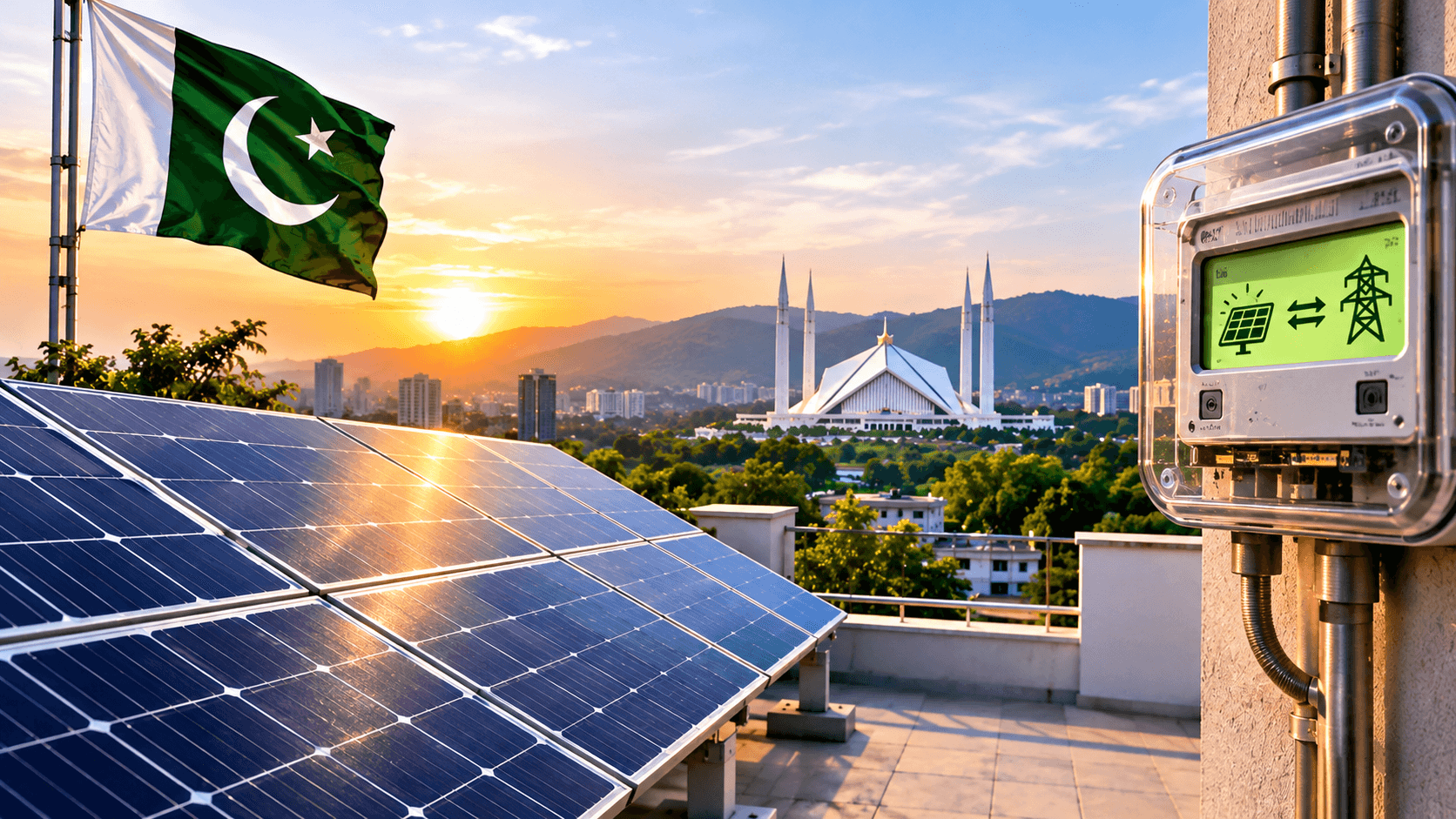
Pakistan’s rapid growth in rooftop solar installations has transformed its electricity landscape. However, changes to the country’s solar compensation policies are creating new challenges for residential and commercial solar consumers.
In February 2026, Pakistan transitioned from its previous net metering framework to a net billing system, changing how electricity exported to the national grid is compensated. While the reform aims to address financial pressures within the electricity sector, new research suggests that the policy change alone may not resolve the deeper structural problems affecting Pakistan’s power industry.
The research, conducted by Muhammad Uzair Yousuf, Assistant Professor at NED University of Engineering and Technology in Karachi, highlights the need for broader reforms involving electricity distribution companies, grid infrastructure, energy storage, and regulatory stability.
Understanding Pakistan’s Shift from Net Metering to Net Billing
Under the previous net metering arrangement, rooftop solar consumers could receive credits for surplus electricity exported to the national grid. These credits helped reduce electricity bills and made solar installations financially attractive for households and businesses.
The new net billing framework changes this arrangement by separating the electricity consumers purchase from the grid and the surplus electricity they export.
Under this model, solar consumers purchase electricity at the applicable retail tariff, while exported electricity receives compensation at a separate buyback rate.
This change has significant implications for the financial returns of rooftop solar installations, particularly for consumers who export a large portion of their electricity generation.
Although the reform is intended to reduce financial pressure on the power sector, its long-term effectiveness depends on addressing other challenges within Pakistan’s electricity system.
How Much Does Net Billing Affect Solar Investment Returns?
One of the most important findings from the research concerns the financial impact on residential solar consumers.
Using an illustrative scenario in which a typical residential solar prosumer consumes 40% of generated electricity on-site and exports the remaining 60% to the grid, the research estimates that the transition to net billing reduces the blended value of rooftop solar generation by approximately 44% to 49%.
This means solar consumers who depend heavily on exporting excess electricity may experience a greater reduction in the financial benefits of their installations.
However, the impact is not identical for every solar owner.
Consumers who use more of their generated electricity directly within their homes or businesses are generally less exposed to lower export compensation.
This makes electricity self-consumption an increasingly important factor when planning a rooftop solar installation in Pakistan.
Pakistan’s Electricity Sector Faces Deeper Structural Challenges
The research emphasizes that Pakistan’s power sector has problems extending far beyond the growth of rooftop solar installations.
Several structural challenges continue to affect electricity distribution and financial sustainability.
1. Electricity Theft and Distribution Losses
Electricity theft and high aggregate technical and commercial (AT&C) losses remain major challenges for Pakistan’s electricity distribution network.
These losses reduce the amount of revenue collected by distribution companies and increase financial pressure across the power sector.
Improving electricity monitoring, strengthening anti-theft measures, and reducing distribution losses are essential steps toward a more sustainable electricity system.
2. Weak Electricity Bill Recovery
Poor bill collection is another significant problem affecting the financial performance of electricity distribution companies.
When consumers fail to pay their electricity bills, distribution companies struggle to recover operational costs and meet financial obligations.
The research suggests that stronger accountability and improved collection mechanisms are necessary to address these problems.
3. Financial Performance of Distribution Companies
Pakistan’s public-sector electricity distribution companies, commonly known as DISCOs, continue to face operational and financial difficulties.
Improving their performance through measurable targets, stronger management accountability, and loss-reduction strategies could help address some of the underlying weaknesses in the electricity sector.
4. Long-Term Power Purchase Obligations
Legacy independent power producer (IPP) capacity obligations also contribute to the financial complexity of Pakistan’s electricity market.
According to the research, reviewing these obligations where feasible could form part of a broader strategy to improve the sector’s financial sustainability.
Why Battery Storage Is Becoming More Important for Solar Consumers
With lower compensation for surplus electricity exports, rooftop solar consumers have a stronger financial incentive to use more of their electricity on-site.
This could accelerate interest in battery energy storage systems (BESS) across Pakistan.
Battery storage allows solar consumers to store excess daytime electricity and use it later, particularly during evening hours when solar generation decreases.
Other strategies can also help improve self-consumption:
- Battery energy storage: Store excess solar electricity for use when sunlight is unavailable.
- Load shifting: Schedule energy-intensive activities during peak solar generation hours.
- Smart energy management: Monitor and optimize household or commercial electricity consumption.
- Electric vehicle charging: Use surplus solar generation to charge electric vehicles during the day.
However, the research cautions against encouraging widespread disconnection from the national grid.
If higher-consuming customers use batteries primarily to eliminate their grid purchases, distribution companies could lose important customers while still carrying the fixed costs of maintaining electricity infrastructure.
Instead, the objective should be to encourage solar-plus-storage solutions that remain connected to the grid and contribute to overall system efficiency.
How Pakistan Could Improve Its Net Billing Framework
The research identifies several policy approaches that could help balance renewable energy growth with the financial requirements of the electricity sector.
Introduce Time-Based Solar Export Compensation
Rather than applying a single flat compensation rate to all exported electricity, Pakistan could consider a time-differentiated export pricing mechanism.
Under this approach, electricity exported during periods of high daytime solar generation could receive a lower compensation rate.
Conversely, exports during periods of higher electricity demand could receive greater compensation.
This approach could better reflect the actual value of electricity at different times of the day.
Provide Targeted Incentives for Solar Battery Storage
Battery installation costs remain a significant barrier for many solar consumers.
The research suggests considering targeted financial support, such as concessional financing or tax relief for certified solar-plus-storage systems.
Rather than introducing broad subsidies for all battery installations, incentives could be designed to encourage solutions that benefit both consumers and the national electricity network.
Maintain Stable and Transparent Solar Policies
Regulatory uncertainty can negatively affect consumer confidence and investment decisions.
Frequent or unexpected changes to solar policies make it difficult for households, businesses, and investors to calculate the long-term financial returns of renewable energy projects.
A predictable regulatory framework would help support continued investment in Pakistan’s solar industry while allowing policymakers to respond to changing electricity market conditions.
Address Electricity Distribution Inefficiencies
Long-term improvements require more than changes to solar export tariffs.
Reducing electricity theft, improving bill recovery, modernizing distribution infrastructure, and strengthening DISCO accountability should remain central priorities.
These reforms could help improve the financial health of the electricity sector without placing the entire burden on rooftop solar consumers.
What Does This Mean for Pakistan’s Solar Industry?
Pakistan’s solar market has experienced significant growth in recent years.
According to analysis cited in the research coverage, distributed solar supplied approximately 27% of Pakistan’s electricity in 2025, while Renewables First estimated the country’s operational solar fleet at around 51 GW as of March 2026.
These figures highlight the growing importance of distributed solar generation in the country’s energy mix.
However, the transition to net billing could influence how consumers approach future solar investments.
Residential and commercial customers may increasingly prioritize:
- Higher on-site solar electricity consumption.
- Battery storage integration.
- Smart energy monitoring systems.
- Energy-efficient appliances and equipment.
- Solar system designs based on actual consumption patterns.
Solar companies and installers may also need to adapt their business models by offering integrated solar-plus-storage solutions rather than focusing exclusively on grid-export-based savings.
Conclusion: Pakistan Needs a Balanced Approach to Solar Energy Growth
Pakistan’s transition from net metering to net billing represents an important change in the country’s renewable energy policy. Although the reform is intended to address financial pressures within the electricity sector, research suggests that tariff adjustments alone cannot solve the industry’s deeper structural problems.
Reducing distribution losses, improving electricity bill recovery, strengthening DISCO performance, encouraging battery storage, and maintaining regulatory stability will all be important for achieving long-term energy sustainability.
For solar consumers, the changing policy environment makes self-consumption and energy storage increasingly important considerations when planning new installations.
Ultimately, Pakistan’s renewable energy future will depend on finding the right balance between encouraging rooftop solar adoption, protecting consumer interests, and maintaining a financially sustainable national electricity grid.
Frequently Asked Questions (FAQs)
1. What is net billing in Pakistan?
Net billing is an electricity compensation arrangement under which solar consumers purchase electricity from the grid at the applicable retail tariff and receive separate compensation for surplus electricity exported to the grid.
2. When did Pakistan introduce the new net billing system?
Pakistan transitioned from its previous net metering framework to net billing in February 2026.
3. How does net billing affect rooftop solar consumers?
Net billing reduces the financial value of surplus electricity exported to the grid. Consumers who use a larger proportion of their solar electricity directly may experience a smaller financial impact.
4. How much has the value of rooftop solar generation decreased?
An illustrative research scenario estimates a reduction of approximately 44% to 49% for a residential prosumer consuming 40% of solar generation and exporting 60%.
5. Will battery storage become more important under net billing?
Yes. Battery storage can help consumers store excess daytime solar generation and use it later, reducing dependence on electricity purchased from the grid.
6. Why is Pakistan changing its solar net metering policy?
The policy transition is intended to address financial pressures within the electricity sector and change how surplus electricity from distributed solar installations is compensated.
However, broader reforms are also needed to address electricity theft, distribution losses, weak bill collection, and other structural challenges.
7. Is solar energy still a good investment in Pakistan?
Solar energy can still offer electricity cost savings, but financial returns depend on installation costs, electricity consumption patterns, system size, applicable tariffs, export compensation, and battery storage costs. Consumers should evaluate these factors before investing.
Research reference: Muhammad Uzair Yousuf, From net metering to net billing: Insights from Pakistan’s 2026 prosumer regulatory reform, published in the journal Next Energy.