


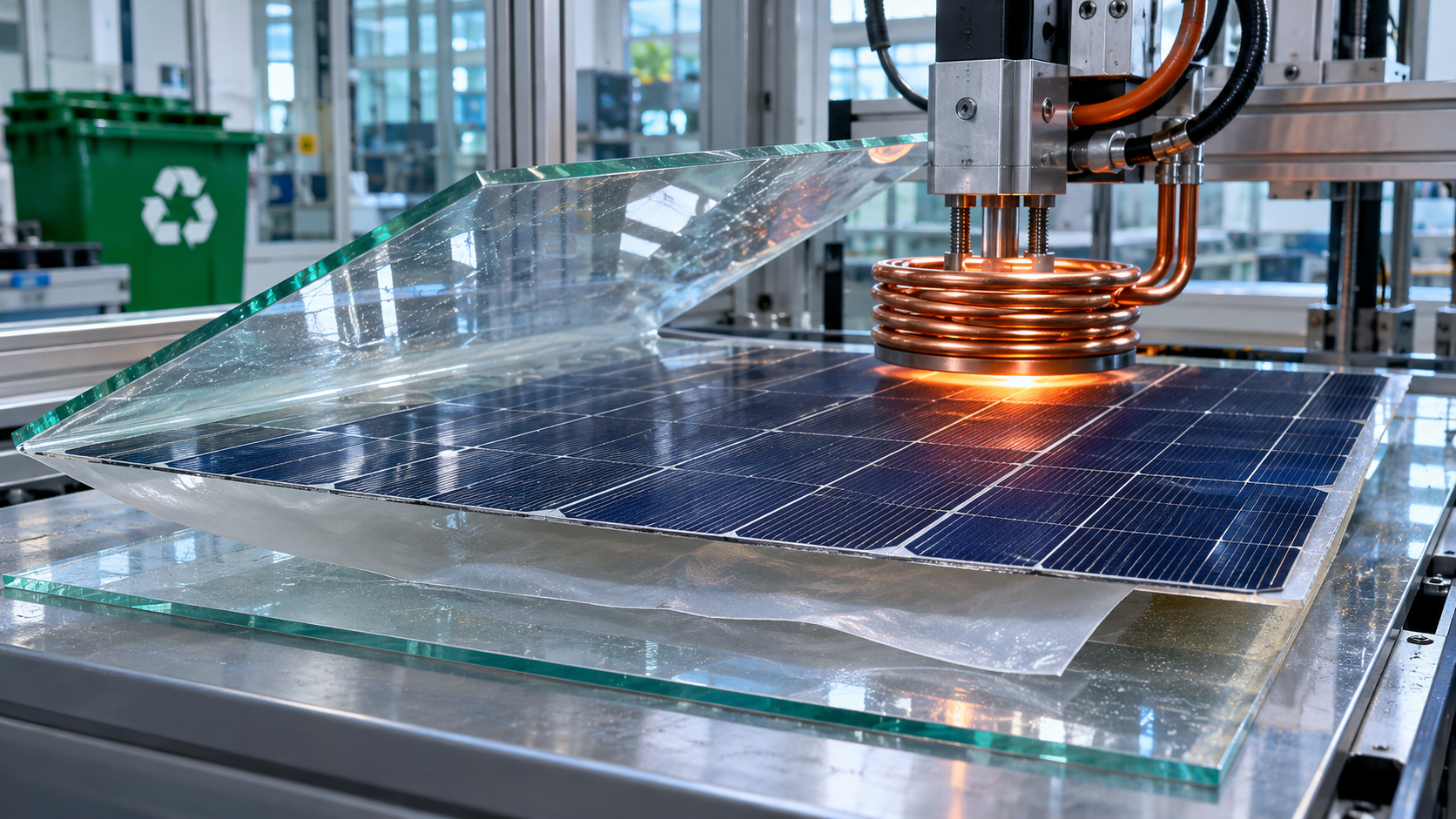
The growing adoption of solar energy is creating a new challenge for the renewable energy industry: how to recycle solar panels efficiently once they reach the end of their operational life. Researchers are now exploring an innovative recycling technique that could make photovoltaic (PV) module recovery significantly faster and more efficient.
An international research team has developed a new induction heating-based solar panel recycling method that can separate the different layers of glass-to-glass photovoltaic modules in as little as five seconds. The technology could help recover valuable materials, including glass, silicon solar cells, and polymer encapsulants, while reducing material waste.
According to the researchers, the experimental process achieved an impressive 99.8% material recovery rate, highlighting its potential to improve the sustainability of solar panel manufacturing and disposal.
How Does the New Solar Panel Recycling Technology Work?
Traditional solar panels contain multiple layers of materials bonded together to protect the photovoltaic cells and maintain long-term performance. Separating these components during recycling can be difficult because the encapsulating polymers firmly hold the layers together.
The newly developed method uses induction heating to address this challenge.
Instead of heating the entire solar panel, the technology uses a high-frequency electromagnetic field to generate heat in the metal contacts of photovoltaic cells. This localized heating causes the surrounding ethylene vinyl acetate (EVA) encapsulant to decompose at the cell interface, allowing the components to separate.
The researchers used a water-cooled copper induction coil operating at frequencies between 270 kHz and 300 kHz to perform the experiments.
Gravity-assisted separation further helped detach the photovoltaic cells from the surrounding materials without requiring extensive mechanical processing.
Experimental Results: Up to 99.8% Material Recovery
The research team tested the technology using modified glass-to-glass mini photovoltaic modules containing PERC solar cells, EVA encapsulant, and tempered glass.
The experiments demonstrated that separation speed improved as the induction coil current increased.
The reported separation times were:
| Induction coil current | Separation time |
|---|---|
| 100 A | 18.6 seconds |
| 150 A | 8.3 seconds |
| 200 A | 5.4 seconds |
The process achieved a material recovery rate of approximately 99.8% of the original module mass.
Researchers also examined the recovered silicon cells using microscopy and spectroscopy. Their analysis found no significant polymer residue or visible structural damage on the recovered cell surfaces.
These results suggest that induction heating could offer an effective way to recover valuable photovoltaic components while minimizing material losses.
Why Glass-to-Glass Solar Panel Recycling Matters
Glass-to-glass solar modules are designed with glass layers on both the front and rear sides of the photovoltaic cells. Although this construction offers durability and protection, separating the materials during end-of-life recycling can be challenging.
Efficient delamination is particularly important because solar panels contain several reusable materials, including:
- Solar glass: Recovered glass can potentially be reused in suitable manufacturing and recycling applications.
- Silicon solar cells: Silicon is a valuable material that could support future photovoltaic manufacturing.
- EVA encapsulants: Polymer materials can be separated and evaluated for further processing or recovery.
- Other module components: Recovering additional materials can help reduce waste and improve overall recycling efficiency.
A faster separation process could make solar panel recycling more practical and economically attractive as the number of retired photovoltaic modules increases.
Can This Technology Be Used for Commercial Solar Panel Recycling?
Despite the promising experimental results, the technology is still at the research and development stage.
The experiments were conducted using small, specially designed photovoltaic samples and mini-modules rather than full-size commercial solar panels.
The researchers identified scaling up the process as an important next step. Future work will focus on testing the technique with larger modules and evaluating its suitability for commercial solar panel recycling facilities.
Several factors will need further investigation, including processing costs, energy consumption, equipment requirements, operational safety, and performance across different photovoltaic module designs.
If successfully scaled, induction heating could become an important part of more efficient solar panel recycling systems.
The Future of Sustainable Solar Energy
Solar energy is widely recognized as an important part of the global transition toward cleaner electricity. However, improving sustainability requires more than installing new solar panels. The industry must also develop effective solutions for managing photovoltaic waste and recovering valuable materials.
Technologies that simplify solar panel disassembly and material recovery could help create a more circular solar energy economy.
The new induction heating-assisted delamination technique represents a promising development in this direction. With an experimental material recovery rate of 99.8% and separation times of only a few seconds, it offers an interesting approach to addressing one of the solar industry’s growing recycling challenges.
Further testing on full-size commercial modules will determine whether this laboratory innovation can become a practical solution for large-scale photovoltaic recycling.
Frequently Asked Questions (FAQs)
1. What is solar panel delamination?
Solar panel delamination is the process of separating the different layers of a photovoltaic module, including glass, silicon solar cells, and polymer encapsulants. It is an important step in recovering reusable materials from retired solar panels.
2. How does induction heating help recycle solar panels?
Induction heating uses electromagnetic energy to generate localized heat in the metal contacts of solar cells. This heat helps decompose the EVA encapsulant around the cells, making it easier to separate the photovoltaic components.
3. What is the reported material recovery rate?
The experimental glass-to-glass mini-modules achieved approximately 99.8% recovery of their original mass.
4. How quickly can the new technology separate solar panel layers?
In the reported experiments, the fastest separation time was approximately 5.4 seconds at an induction coil current of 200 A. An earlier test configuration also demonstrated separation in approximately five seconds.
5. Is this solar panel recycling technology commercially available?
Not yet. The technology has been demonstrated in laboratory experiments, and researchers plan to investigate its application to full-size commercial photovoltaic modules.
6. Which materials can be recovered from solar panels?
Solar panel recycling can recover materials such as glass, silicon solar cells, aluminum, copper, and polymer encapsulants, depending on the module design and recycling process.
Source and Research: The findings are based on research published in Communications Materials under the title “Inductive heating for photovoltaic module recycling and near-complete component recovery.”